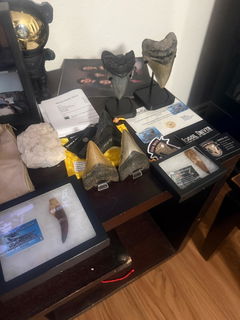
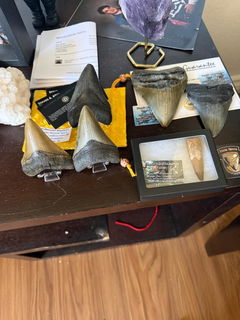
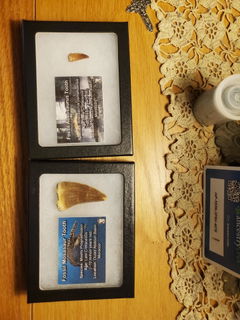
Own a genuine fossil tooth from one of Megalodon's earliest ancestors with this 2.09" Otodus sokolovi shark tooth, recovered from the Eocene marine deposits near Dakhla in Western Sahara. Long sold under the name auriculatus, this species is prized for its serrated blade and distinctive side cusps, and this specimen features beautiful tan enamel, razor-sharp serrations, and intact cusps, all with no repair or restoration.
Shed during the Middle to Late Eocene Epoch (roughly 34 to 47 million years ago), this tooth predates Megalodon by more than 20 million years and offers a direct look at an early chapter in the evolution of the largest shark that ever lived. Every Fossil Driven specimen is 100% authentic, hand-selected, and unrestored, giving collectors total confidence.
Item Specifics
-
Species: Otodus sokolovi (formerly Carcharocles auriculatus)
-
Size: 2.09" × 1.82"
-
Location: Dakhla, Western Sahara
-
Age: Middle to Late Eocene (~34 to 47 million years old)
-
Condition: 100% natural, no repair or restoration (see our Authenticity Guarantee)
About This Specimen
This Western Sahara Otodus sokolovi tooth displays beautiful tan enamel, razor-sharp serrations, and intact cusps. An overall phenomenal specimen for the location. Measuring 2.09" by 1.82", it has the broad, triangular build and paired side cusps that make this species so recognizable.
Many teeth from this locality reach the market with repaired root cracks or fill work, which makes a fully natural, unrepaired specimen like this one a cleaner choice for collectors who want their fossils exactly as they came out of the ground.
All Fossil Driven fossils are guaranteed authentic, unrestored, and accurately photographed.
Where This Fossil Comes From
This tooth was recovered from Eocene marine sediments near Dakhla, a coastal city on a long, narrow peninsula along the Atlantic coast of Western Sahara. Tens of millions of years ago, this stretch of northwest Africa sat beneath warm, shallow seas that supported sharks, rays, bony fish, and early whales. Today the region is desert, and erosion slowly exposes these ancient seafloor layers, allowing teeth like this one to be recovered by local collectors.
The Dakhla area has become one of the most important sources of Eocene shark teeth in the world, giving collectors access to species that are much harder to find elsewhere.
About Otodus sokolovi and the Megalodon Lineage
Otodus sokolovi belongs to the same evolutionary line that eventually produced Otodus megalodon. Paleontologists view it as a transitional species sitting between Otodus auriculatus and the later Otodus angustidens. For years, teeth like this were labeled auriculatus, and you'll still see both names used today.
The lineage is easy to follow in the teeth themselves. Early members like sokolovi had serrated blades flanked by distinct side cusps. Over millions of years, through angustidens and chubutensis, those cusps shrank and eventually disappeared, leaving the broad, cuspless, finely serrated teeth of Megalodon. Owning a sokolovi tooth means owning one of the early steps in that story.
Why Collect This Tooth
- Genuine fossil Otodus sokolovi (auriculatus) tooth
- Early Megalodon ancestor from the Eocene Epoch
- No repair or restoration, uncommon for this locality
- Classic serrated blade with side cusps
- Pairs perfectly with angustidens, chubutensis, and Megalodon teeth for a lineage display
- Excellent gift for shark and fossil enthusiasts
Learn More & Explore Related Fossils
Why Buy from Fossil Driven
- Hand-selected, authentic fossils only
- No restoration unless clearly disclosed
- Clear, accurate photography of each specimen
- Fast, secure shipping
- Small, enthusiast-owned business passionate about fossils
Final Notes
Add this authentic Otodus sokolovi tooth from Western Sahara to your collection and own a real piece of Megalodon's deep ancestry. Every Fossil Driven specimen is verified for authenticity: no repairs, no restorations, just genuine fossil material preserved for tens of millions of years.
Brandon Zulli & the Fossil Driven Team