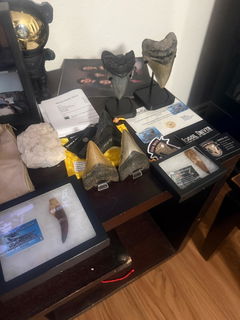
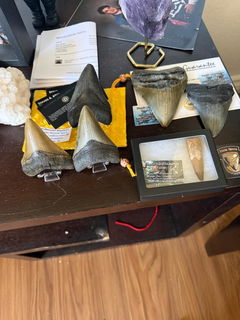
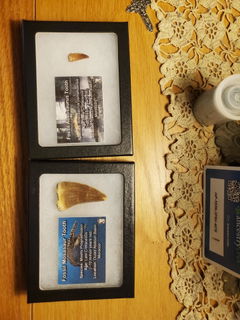
This authentic fossil Great White shark tooth (Carcharodon carcharias) measures 2.23 inches in length and 1.65 inches in width and was recovered from the fossil-bearing marine deposits of Banten, Indonesia. Located on the western tip of the island of Java, Banten sits within one of Southeast Asia's most productive fossil shark tooth regions, where ancient seafloor sediments have been uplifted and exposed over millions of years.
This specimen displays beautiful natural coloration created through millions of years of mineralization. The enamel shows soft cream and butterscotch tones mottled with blue-gray, accented by a warm orange band along the bourlette and natural fine lines running through the blade. The serrations are coarse, sharp, and well-defined along both cutting edges, and the tan root is complete with good thickness. A few small natural enamel spots add character without taking away from the overall preservation. Fossil Great White teeth from Indonesia are increasingly popular among collectors thanks to their unique color palettes, which look noticeably different from the darker teeth typically found along the U.S. Atlantic Coast.
About the Great White Shark
The Great White shark (Carcharodon carcharias) is one of the most well-known predatory sharks in both the fossil record and modern oceans. Fossil Great White teeth appear in marine deposits from the late Miocene and Pliocene epochs, when these sharks began evolving into the species recognized today.
Like all sharks, Great Whites have skeletons composed primarily of cartilage rather than bone, which rarely fossilizes. Because of this, the majority of their fossil record consists of teeth. Over the course of its lifetime, a single shark can shed thousands of teeth, many of which become buried in ocean sediments and eventually fossilize. Fossil Great White teeth provide valuable insight into the evolutionary history of modern sharks and how far this species spread across the world's oceans, including the warm tropical seas that once covered much of present-day Indonesia.
The Evolution of the Modern Great White Shark from Ancient Mako Ancestors
Identifying a Fossil Great White Shark Tooth
Great White shark teeth are easily recognized by their broad triangular crown and sharp serrated edges. These serrations allowed the shark to cut through large prey such as marine mammals, fish, and other ocean animals.
Compared to earlier shark species, Great White teeth typically have a thicker blade and coarser, more uniform serrations along the cutting edges. This specimen shows those features clearly, with large, evenly spaced serrations running from root to tip. Their distinctive shape has remained remarkably consistent over millions of years, which is why fossil Great White teeth often look very similar to those from modern sharks. Collectors appreciate these fossils because they represent a direct connection between prehistoric oceans and a species that still exists today.
Fossilization and Natural Color Variation
The colors seen in fossil Great White shark teeth are the result of mineral replacement during the fossilization process rather than the tooth's original color. As the tooth is buried within marine sediments, minerals gradually replace organic material over millions of years, producing natural hues such as gray, tan, brown, blue, and black.
These color variations depend on local sediment composition and chemical conditions during fossilization. Indonesian teeth are known for lighter, warmer tones like cream, butterscotch, and caramel, often mixed with gray or blue, which sets them apart from teeth found in other parts of the world. Because each fossil forms under slightly different conditions, no two fossil shark teeth are exactly the same.
Why Fossil Shark Teeth Have Different Colors
Authentic Fossil Shark Teeth
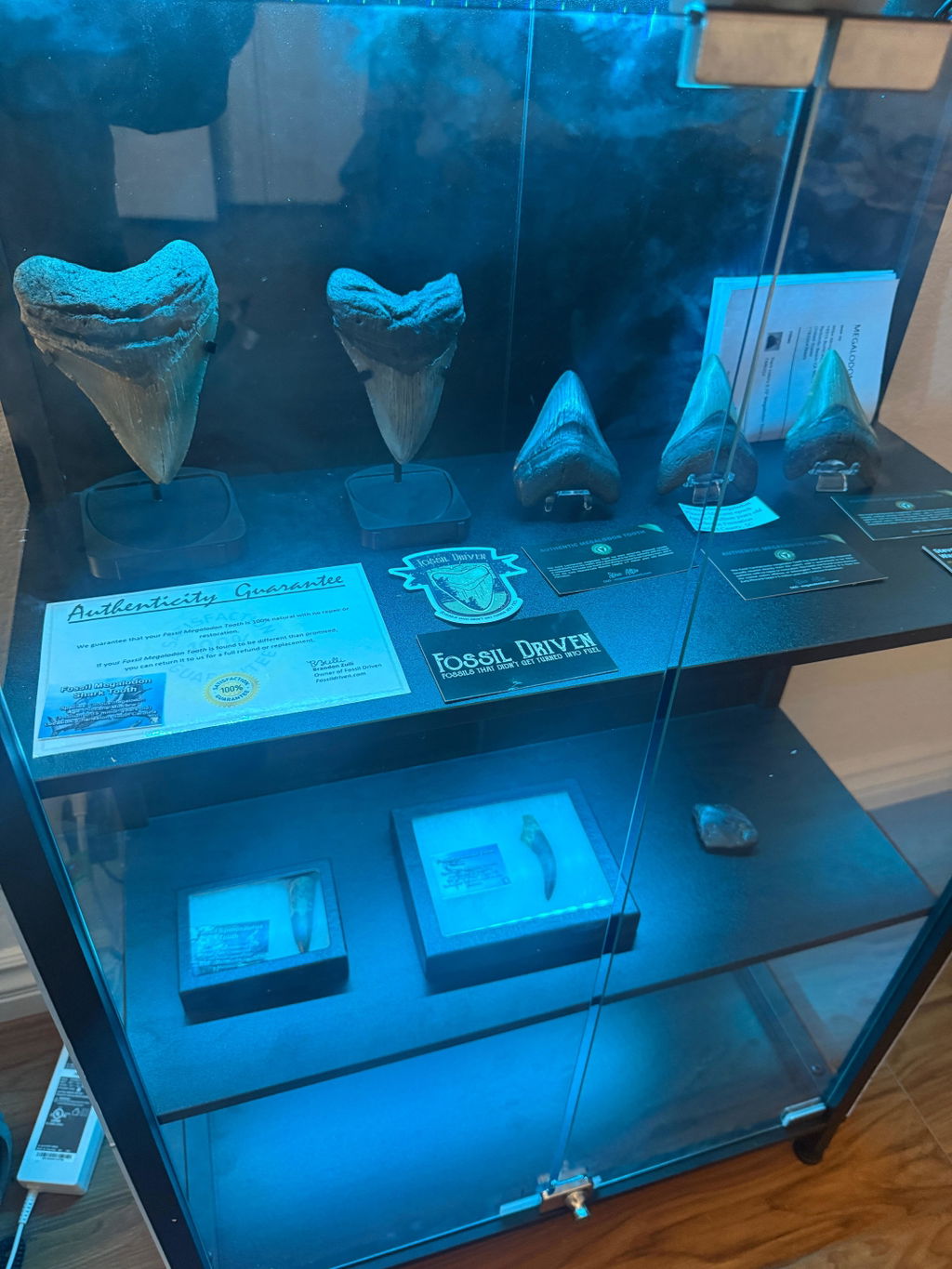
All fossil Great White teeth offered by Fossil Driven are authentic prehistoric fossils, not replicas or casts. Indonesian shark teeth are frequently restored or enhanced before reaching the market, so every specimen we offer is carefully inspected, and this tooth is 100% natural with no restoration. Each specimen formed naturally over millions of years and represents a genuine piece of ancient marine history.
Fossil Great White teeth are highly collectible because they bridge the gap between prehistoric sharks and one of the most famous species still living in modern oceans.
A Unique Piece of Ocean History
Owning a fossil Great White shark tooth provides a tangible connection to ancient seas and the powerful predators that once dominated them. This Banten specimen adds an international locality to any collection, with color and character you won't find in North American teeth.
For collectors and enthusiasts alike, a fossil Great White tooth represents both a scientifically important specimen and a striking display piece.