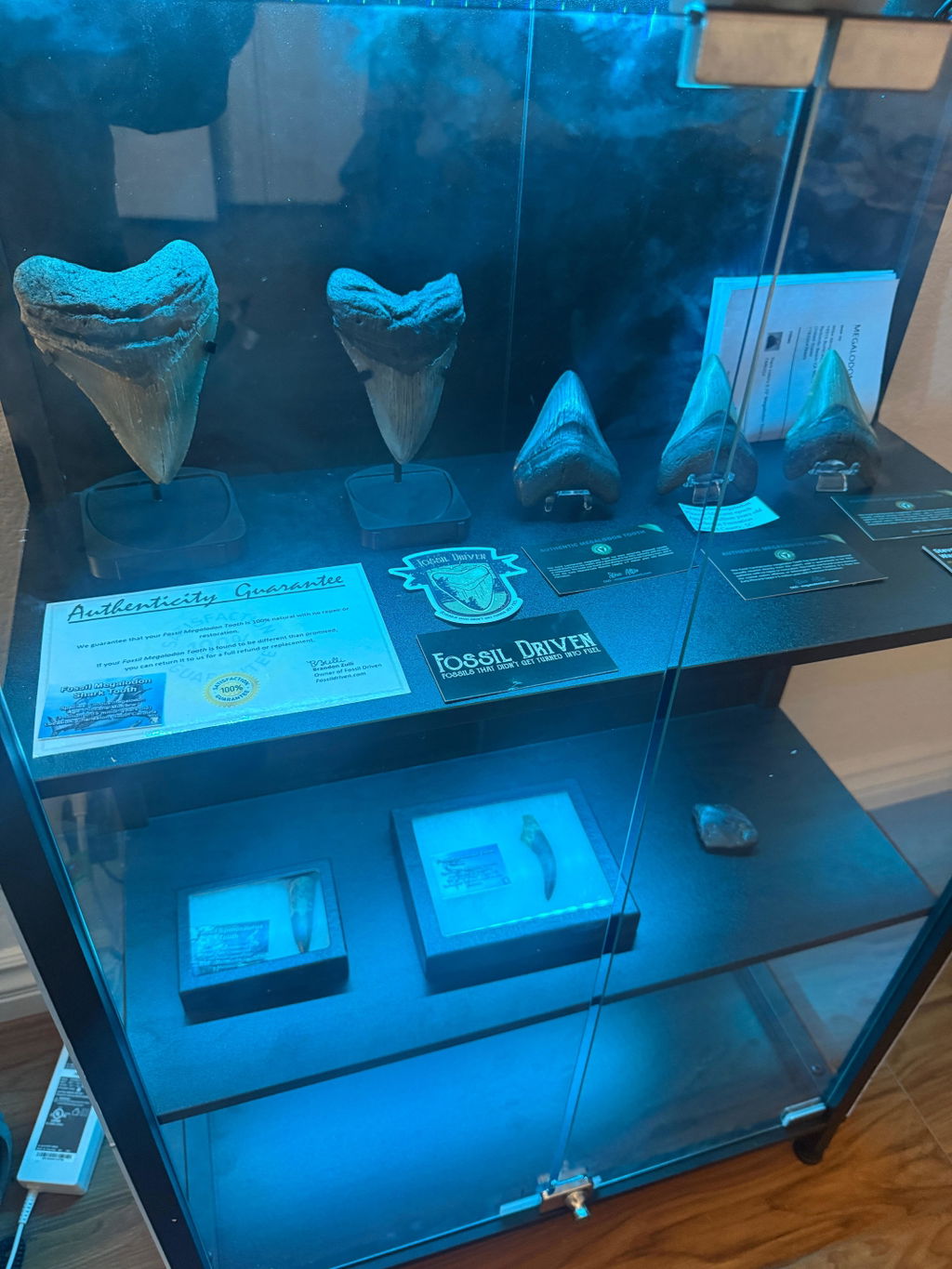

Why Do Fossil Megalodon Teeth Change Color When They Dry?
One of the most common questions new fossil hunters and collectors ask after recovering a fossil shark tooth is why it suddenly looks different a few hours later. A freshly found Megalodon tooth pulled from the wet sand, river sediment, or the ocean floor often shows deep, vibrant coloration. Many collectors hope that the beautiful blue, tan, black, or gray color will remain permanent. However, after the tooth sits out overnight, it frequently lightens, contrast decreases, and the overall appearance changes. Certain patterns in the enamel may fade, but there's also a chance that they may stand out more. It all depends on how it dries and what material deposits the fossil shark tooth absorbed during the fossilization process. A great example of this can be Golden Beach Megalodon teeth that are found in Venice, Florida.

Photo Credit: Fossils Online
This surprises many collectors, especially those who have just recovered their first real Megalodon tooth. Some worry they damaged the fossil during the trip home or left it in the sun too long to dry. In reality, nothing is wrong at all. When a fossil Megalodon tooth changes color while drying, you are not watching it fade; you are watching its true mineral composition become visible. To understand why this happens, it helps to understand what a fossil Megalodon tooth actually is.
What Is a Fossil Megalodon Tooth?
A Megalodon tooth is no longer a normal biological tooth. Millions of years ago, the original enamel and dentin belonged to the prehistoric shark Otodus megalodon (historically also referred to as Carcharocles megalodon), the largest predatory shark ever known. After the shark shed one of its teeth, it became buried in sediment and remained there for millions of years.
Over time, groundwater rich in dissolved minerals slowly moved through the buried tooth. This process, often known as fossilization, replaced organic material while preserving the microscopic structure of the tooth. The fossil essentially became mineralized stone while still retaining the shape, serrations, and internal features of the original shark tooth.
The colors seen in fossil Megalodon teeth are not their original living color (duh). Instead, they come from minerals absorbed during the fossilization process. Iron oxides, manganese compounds, phosphate minerals, and other trace elements entered microscopic pore spaces within the tooth. These minerals determine whether a fossil shark tooth appears black, tan, gray, blue-gray, brown, orange, or even greenish, depending on the burial environment and locality.
Why a Freshly Found Megalodon Tooth Looks More Colorful
When a tooth is freshly discovered, its pores are filled with water. Fossil teeth are surprisingly porous at a microscopic level, especially in the dentin and bourlette areas. Water occupying those pores dramatically changes how light interacts with the fossil.
This water allows light to pass into the tooth instead of immediately reflecting off the surface. Because of this, mineral staining within the fossil becomes visible, and color appears deeper and richer. This is why a tooth found while diving or digging a land site may display intense coloration immediately after recovery.
As the tooth dries, evaporation removes water from the pore structure and air replaces it. Air scatters light instead of transmitting it. Light now reflects off the outer surface instead of penetrating into the fossil. The mineral chemistry is still present, but it becomes less visible to the eye. The fossil shark tooth tends to lighten and lose contrast. In simpler terms, the tooth is not losing color; it's just losing water. Obviously, this isn't always the case, but it happens more often than not. But we'll go into more detail on this later.


The example above shows the dramatic change that a fossil Megalodon tooth can have as it dries. The first picture showcases how a tooth can look when it is freshly found. Beautiful blue hues and a distinct chevron pattern in the bourlette. As it dried, the tooth lightened in color dramatically and lost that beautiful blue coloration. The Megalodon tooth now looks like it fell right out of the shark's mouth with an even, gorgeous, almost bone-white look.
Photo Credit: Matt Battista, the fossil hunter who found this amazing specimen and the one and ONLY owner of this top 0.1% fossil Megalodon tooth.
The Optical Science Behind the Change
Now, let's dive into more of the science behind this optical change. This effect is caused by refractive index differences. Water has optical properties closer to fossilized enamel and dentin than air does. When the tooth is wet, light travels into the fossil and reveals mineral staining. When dry, microscopic air pockets scatter light, producing a pale or chalky appearance. This is the same reason wet rocks, seashells, and beach sand appear darker after being soaked. Fossil shark teeth simply exaggerate the effect because of their porous mineral structure.
Collectors often notice this most dramatically in landsite or river teeth. A tooth pulled from clay or phosphate sediment may appear deep blue-gray or black while wet but dry to a light tan or gray within a day. Conversely, some teeth may appear dull at first and then develop stronger contrast patterns after drying as oxidation stabilizes the surface minerals.
Minor Oxidation After Recovery
There is also a small chemical change involved. When certain minerals, particularly iron-bearing compounds, are exposed to oxygen after long burial, mild surface oxidation can occur. This does not damage the fossil. Instead, it stabilizes the outer mineral layer and may slightly enhance color contrast during the first day or two after recovery.
Because of this, some newer or amateur collectors sometimes believe darker coloration is artificial. In reality, natural color variation is one of the strongest indicators of authenticity. Fossil Megalodon teeth display colors directly tied to the sediment in which they fossilized.
To learn more about how these natural colors form, you can read our guide explaining why Megalodon teeth have different colors.
Why Location Matters
Different fossil localities produce different drying behaviors. Marine deposits often produce darker teeth, river sediments commonly show stronger contrast between the blade and bourlette, and land sites frequently reveal warmer iron-rich tones after drying. The coloration of a fossil Megalodon tooth is essentially a geological fingerprint created by the sediment and groundwater chemistry that preserved it millions of years ago.
Because of this, experienced collectors can often estimate where a tooth was found simply by examining its color and mineral patterning. If you are curious about the most common discovery areas and the types of fossils each region produces, you can also read our guide on where Megalodon teeth are typically found around the world.
Frequently asked questions
Will my megalodon tooth's color change back if I get it wet again? Yes. The color shift is reversible since it's caused by water filling the tooth's microscopic pores, not a permanent chemical change. Wetting a dried tooth will temporarily bring back its deeper, richer coloration.
Is it normal for a tooth to look completely different after a day of drying? Yes, this is extremely common and expected, especially with teeth recovered from rivers, land sites, or underwater. A dramatic shift from vibrant blue or black to a lighter tan or bone-white color does not mean anything is wrong with the fossil.
Does color change affect a megalodon tooth's value? Not directly. Collectors evaluate value based on size, serration quality, enamel preservation, and overall eye appeal. Natural color variation, including how a tooth looks once fully dried, is simply part of its authentic character.
Can I do anything to keep the wet, vibrant color permanently? Some collectors apply specific sealants or finishes to preserve a wet look, though this is a personal preference and not something every collector chooses to do. Most prefer to let the fossil dry naturally and display it in its true, stable state.
Why do some teeth get more colorful after drying instead of less? It depends on the minerals involved. While many teeth lighten as water evaporates, some develop stronger contrast as surface oxidation stabilizes certain minerals, which is why no two specimens dry exactly the same way.
The Story Hidden in the Fossil
As the fossil stabilizes, its final color represents millions of years of geological history. The shades record sediment type, groundwater chemistry, and burial conditions that preserved the tooth long before humans existed. So when a Megalodon tooth changes color after you bring it home, nothing is wrong with it. You are simply witnessing its history becoming visible. The water was masking the mineral structure, and as the tooth dries, that prehistoric story finally appears. Because every fossil preserves a different environment, no two Megalodon teeth ever look exactly alike. Collectors often come to appreciate that these variations are not flaws, but evidence of authenticity and natural preservation.
If you would like to see these natural differences for yourself, you can browse our collection of authentic fossil Megalodon teeth for sale and compare how coloration varies from specimen to specimen.
Written by: Brandon Zulli - Owner of Fossil Driven