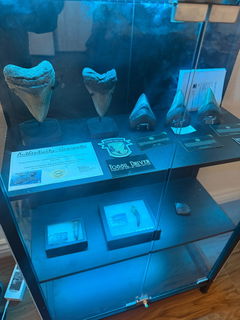
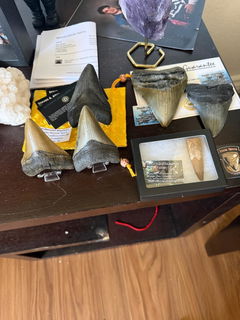
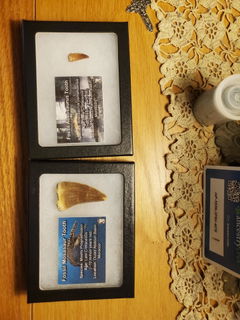
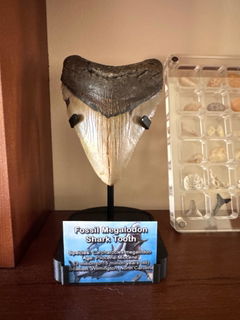
This fossil shark tooth has sold! We regularly source new fossil shark teeth from locations worldwide. If you're looking for something similar, browse our current collection below.
👉 Fossil Shark Teeth for Sale
2.03" Fossil Great White Shark Tooth (Carcharodon carcharias) – South Carolina
This authentic fossil Great White shark tooth (Carcharodon carcharias) measures approximately 2.03 inches in length and 1.35 inches in width and was recovered from the fossil-rich marine deposits near Beaufort, South Carolina. Fossil shark teeth from this region originate from ancient coastal sediments along the Atlantic Coastal Plain, where prehistoric seas once covered much of the southeastern United States.
This specimen displays natural fossil coloration created through millions of years of mineralization within marine sediments. The tooth preserves the classic triangular blade shape and serrated cutting edges that make Great White shark teeth instantly recognizable. These serrations allowed the shark to efficiently slice through prey, making it one of the most formidable marine predators of its time.
Fossil Great White teeth from South Carolina are particularly desirable among collectors due to their strong preservation and their connection to one of the most iconic sharks still living in today’s oceans.
About the Great White Shark
The Great White shark (Carcharodon carcharias) is one of the most well-known predatory sharks in both the fossil record and modern oceans. Fossil Great White teeth date back millions of years, appearing in marine deposits from the Miocene and Pliocene epochs, when these sharks began evolving into the species recognized today.
Like all sharks, Great Whites have skeletons composed primarily of cartilage rather than bone, which rarely fossilizes. Because of this, the majority of their fossil record consists of teeth. Over the course of its lifetime, a single shark can shed thousands of teeth, many of which become buried in ocean sediments and eventually fossilize.
Fossil Great White teeth provide valuable insight into the evolutionary history of modern sharks and the marine ecosystems they once inhabited.
The Evolution of the Modern Great White Shark from Ancient Mako Ancestors
Identifying a Fossil Great White Shark Tooth
Great White shark teeth are easily recognized by their broad triangular crown and sharp serrated edges. These serrations allowed the shark to cut through large prey such as marine mammals, fish, and other ocean animals.
Compared to earlier shark species, Great White teeth typically have a thicker blade and more uniform serrations along the cutting edges. Their distinctive shape has remained remarkably consistent over millions of years, which is why fossil Great White teeth often look very similar to those from modern sharks.
Collectors often appreciate these fossils because they represent a direct connection between prehistoric oceans and a species that still exists today.
Fossilization and Natural Color Variation
The colors seen in fossil Great White shark teeth are the result of mineral replacement during the fossilization process rather than the tooth’s original color. As the tooth is buried within marine sediments, minerals gradually replace organic material over millions of years, producing natural hues such as gray, tan, brown, blue, and black.
These color variations depend on local sediment composition and chemical conditions during fossilization. Because each fossil forms under slightly different conditions, no two fossil shark teeth are exactly the same.
Why Fossil Shark Teeth Have Different Colors
Authentic Fossil Shark Teeth
All fossil Great White teeth offered by Fossil Driven are authentic prehistoric fossils, not replicas or casts. Each specimen formed naturally over millions of years and represents a genuine piece of ancient marine history.
Fossil Great White teeth are highly collectible because they bridge the gap between prehistoric sharks and one of the most famous species still living in modern oceans.
A Unique Piece of Ocean History
Owning a fossil Great White shark tooth provides a tangible connection to ancient seas and the powerful predators that once dominated them. These fossils remain popular among collectors due to their recognizable shape, strong preservation, and connection to a species that continues to inspire fascination today.
For collectors and enthusiasts alike, a fossil Great White tooth represents both a scientifically important specimen and a striking display piece.