
Why Did the Megalodon Go Extinct?
Share
For nearly 20 million years, Otodus megalodon was the undisputed apex predator of Earth's oceans. It hunted prehistoric whales, dominated every warm coastline on the planet, and grew to sizes that are still debated by scientists today. Then, roughly 3.6 million years ago, it was gone.
The extinction of megalodon is one of the most studied and debated events in paleontology. It was not a single catastrophic moment but a slow collapse driven by several overlapping forces that combined at the worst possible time for an animal that had been so dominant for so long. Here is what the science actually shows.
When Did Megalodon Go Extinct?
The exact timing has shifted over the years as more fossil data have become available. Older estimates placed megalodon's extinction closer to 2.6 million years ago at the Pliocene-Pleistocene boundary. A more recent 2019 study narrowed the range to somewhere between 4 and 3.2 million years ago, with a median estimate around 3.5 million years ago. No confirmed megalodon fossil has ever been found beyond the Pliocene-Pleistocene boundary.
What we do know is that megalodon had been shedding teeth into ocean sediment for millions of years, which is exactly why fossil megalodon teeth are still found today by collectors and fossil hunters all over the world. About 3.6 million years ago, those teeth simply stopped appearing in the fossil record.
The World Was Changing Around It
To understand why megalodon went extinct, you first have to understand why it thrived. During the warmer climate of the Miocene epoch, Earth's oceans were broadly warmer and rich with biodiversity. That warmth supported enormous populations of the large, slow-moving baleen whales that megalodon depended on as its primary food source. An animal of megalodon's size needed enormous amounts of food to sustain itself, and the Miocene ocean delivered.
Then the climate shifted. As Earth entered a prolonged cooling period during the late Pliocene, ocean temperatures dropped significantly. The closing of the Central American Seaway approximately 3 million years ago, when North and South America fully connected, disrupted ocean circulation patterns in ways that further reduced global temperatures and altered marine ecosystems that had been stable for millions of years.
Its Food Supply Collapsed
The cooling climate did not just shrink megalodon's habitat; it devastated its food supply. Scientists estimate that roughly a third of all large marine megafauna went extinct during this period. The diverse baleen whale populations that had been so abundant during the Miocene declined sharply in both species diversity and overall numbers.
The whale species that did survive began migrating toward cooler polar waters to follow the cold-water prey they depended on. Megalodon, adapted to warm coastal environments, could not follow them. Its hunting grounds were shrinking while the prey it needed to survive was moving beyond its reach.
An animal of megalodon's size had enormous metabolic demands. One estimate suggests a megalodon the size of IRSNB P 9893, one of the better-known vertebral column specimens, would have required roughly 98,000 calories per day to sustain itself, about 20 times the caloric requirement of an adult great white shark. When the food supply collapses for an animal with demands that high, the consequences are severe.
Competition From New Predators
Megalodon did not face a depleted ocean alone. The late Pliocene saw the rise of new and more agile apex predators competing for the same shrinking prey base. Ancestors of the modern great white shark were evolving during this period and occupied a similar position in the food chain. Research has shown that early great whites and megalodon were hunting the same marine mammals, meaning direct competition for food was intensifying at exactly the wrong time.
Great white sharks are smaller, faster, and capable of hunting in colder waters that megalodon could not tolerate. As conditions shifted against megalodon, those traits gave its competitors a significant survival advantage. The orcas that emerged during this period also introduced pack-hunting tactics that added further pressure on large marine prey populations.
The Nursery Areas Were Destroyed
One factor that is sometimes overlooked is the loss of megalodon's nursery habitats. Like modern sharks, megalodon young were born in warm, shallow coastal waters where they could grow in relative safety before moving into open ocean environments. Research has confirmed nursery sites in locations like Panama, where juvenile megalodon teeth have been found in concentration.
As sea levels dropped and global cooling continued, many of those shallow coastal nursery zones disappeared or became unsuitable. The loss of safe breeding and juvenile development habitat is a serious blow to any large predator species with slow reproduction rates, and megalodon was particularly vulnerable given how dependent it was on specific environmental conditions.
Could a Supernova Have Contributed?
This one might sound far-fetched, but it has actually been studied seriously. Some researchers have proposed that a supernova approximately 150 light-years from Earth around 2.6 million years ago may have contributed to the extinction event that ended megalodon's reign. The theory suggests the resulting radiation would have penetrated ocean waters and persisted long enough to affect marine ecosystems at multiple levels of the food chain.
This remains a fringe hypothesis rather than a scientific consensus, but it illustrates just how seriously researchers take the megalodon extinction question and the range of factors they are willing to examine.
A Perfect Storm of Pressures
The honest answer to why megalodon went extinct is that no single cause was solely responsible. Climate change, prey collapse, habitat loss, increased competition, and the destruction of nursery areas all converged at roughly the same time. An animal that had been perfectly suited to the Miocene ocean found itself increasingly mismatched to a world that was rapidly changing around it.
The irony is that megalodon's own success may have contributed to its downfall. A predator that large, with metabolic demands that high, has almost no margin for error when prey populations decline. Smaller, more adaptable predators could weather the storm. Megalodon could not.
What Megalodon Left Behind
Megalodon's extinction reshaped ocean ecosystems in ways that echo to this day. With the ocean's most dominant apex predator gone, large marine mammals, including the ancestors of the modern blue whale, were freed to grow to sizes that would not have been viable with megalodon still hunting. The largest animals alive on Earth today exist in part because megalodon no longer does.
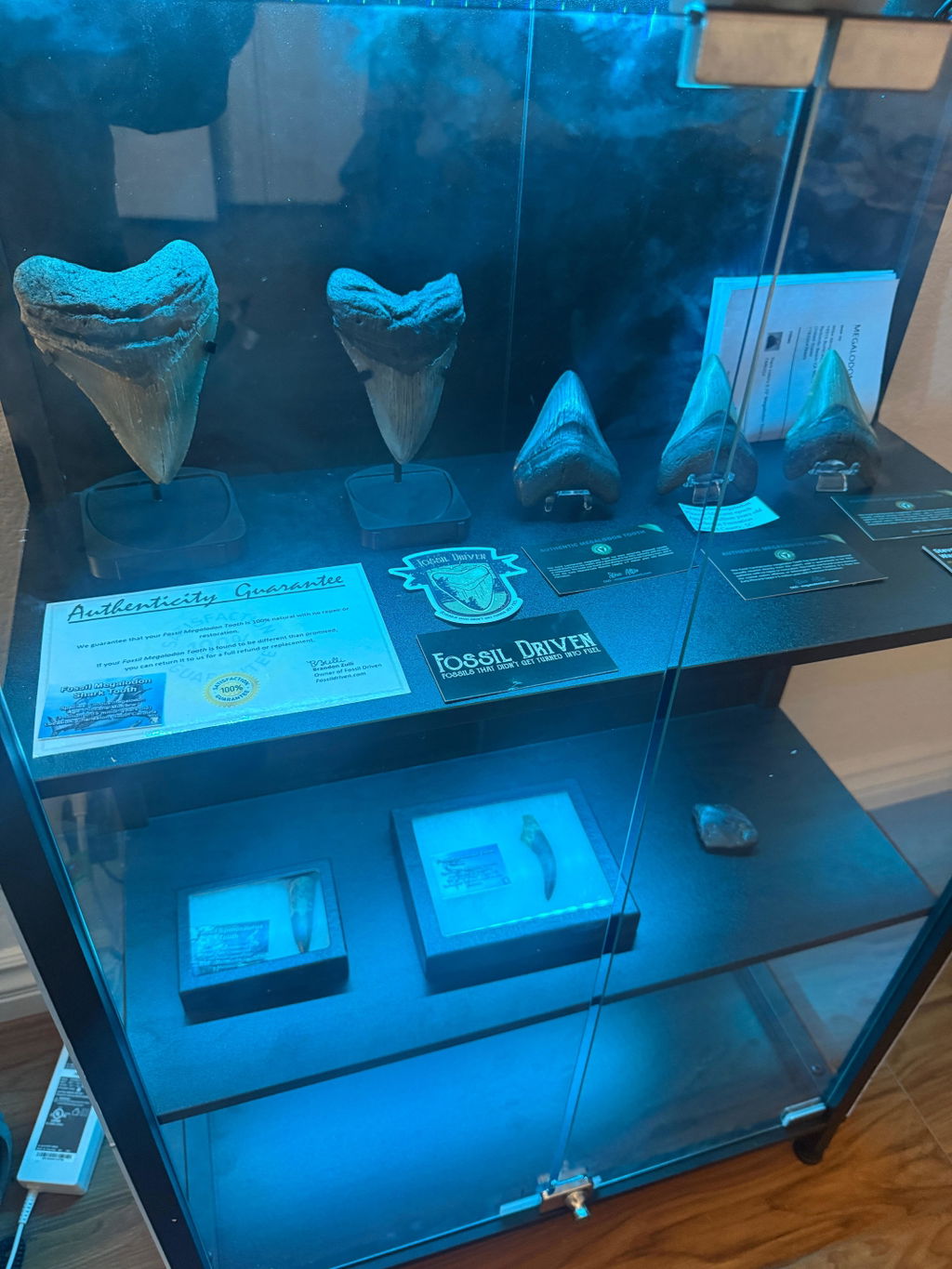
What it left behind are its teeth, millions of fossilized specimens preserved in marine sediments around the world, ranging from small juvenile examples to massive 7-inch specimens that still take your breath away. If you want to learn more about where these incredible fossils come from, our guide to where megalodon teeth are found worldwide covers the most productive fossil localities on the planet. Or if you are ready to add one to your collection, browse our full selection of authentic megalodon teeth for sale, each one a genuine relic of one of the most extraordinary predators that ever lived.
Written by: Brandon Zulli, Owner of Fossil Driven