
Is the Megalodon Still Alive? The Science Explained

Few questions about prehistoric life generate as much debate online as this one. Between blockbuster movies, Shark Week specials, and endless YouTube videos, the idea that a 60-foot shark might still be lurking somewhere in the deep ocean has taken on a life of its own. It is a thrilling thought. It is also wrong.
The short answer is no. Otodus megalodon is extinct. It has been extinct for roughly 3.6 million years, and the scientific evidence supporting that conclusion is overwhelming. But the longer answer is actually more interesting than a simple yes or no, because understanding why scientists are so confident tells you a lot about how the fossil record works and just how remarkable this animal really was.
Where Did the Idea Come From?
The modern megalodon myth got a massive boost in 2013 when the Discovery Channel aired a fictionalized documentary during Shark Week suggesting the shark might still be alive. Every scientist depicted in the program was a paid actor. There was no disclosure that the content was fictional. A poll taken after the broadcast found that 73% of viewers walked away believing megalodon was not extinct. Discovery aired follow-up programs in 2014 with similar backlash from the scientific community each time.
Movies like The Meg added fuel to the fire. The result is a generation of people who genuinely are not sure whether this animal survived into modern times. It is an understandable confusion, but the science tells a clear story.
What the Fossil Record Actually Shows
Megalodon existed for roughly 16 to 20 million years across oceans worldwide. During that time, it shed an enormous number of teeth. Sharks continuously replace their teeth throughout their lives, and megalodon was no exception. The ocean floor became littered with fossilized megalodon teeth over millions of years, which is a big part of why they are still found today by collectors and fossil hunters all over the world.
Here is the key point: the youngest confirmed megalodon teeth in the fossil record date to approximately 3.6 million years ago. After that point, nothing. No teeth. No bite marks on whale bones. No unfossilized specimens pulled up by fishing trawlers or deep-sea equipment. If megalodon were still alive, its teeth would still be falling to the ocean floor, and those recent teeth would not yet be fossilized. We would be finding them. We are not. Learn more about why fossil megalodon teeth look the way they do and what millions of years of mineralization actually produces.
But We Have Only Explored 5% of the Ocean...
This is the argument that keeps the megalodon myth alive more than any other. If we have only mapped a fraction of the deep ocean, how can scientists be certain nothing is hiding down there?
It sounds reasonable on the surface, but it falls apart when you consider megalodon's biology. This was not a deep-sea creature. Megalodon was adapted for warm, shallow coastal waters where large prey like prehistoric whales were abundant. The deep ocean is cold, dark, and food-scarce. A warm-water predator of megalodon's size could not survive in those conditions, and there would be nothing down there large enough to sustain it even if it could.
The comparison to giant squids is often made here. We rarely see them, yet we know they exist because stressed and dying individuals occasionally surface, and sperm whales carry sucker-mark scars as evidence of underwater battles with them. A 60-foot apex predator hunting whales in coastal waters would leave far more obvious evidence than sucker marks. We would see bite wounds on whale carcasses. We would find recent teeth. We would have confirmed sightings. None of that exists.
The Bite Mark Argument
This is one of the most straightforward pieces of evidence against a living megalodon. Marine biologists and paleontologists regularly study whale carcasses and bones. Megalodon bite marks on whale bones are well documented in the fossil record from the Miocene and Pliocene. 3.6 million years ago, those bite marks disappeared completely.
Today, we monitor whale populations more closely than ever before. Researchers track individual animals across entire ocean basins. A predator capable of taking down a whale the size of Megalodon would be leaving obvious evidence on the whales it attacked. That evidence simply does not exist.
A Population Cannot Survive on One or Two Individuals
Even setting aside the habitat and prey arguments, consider what it would take to sustain a living megalodon population over 3.6 million years. You cannot maintain a species with two or three individuals. A viable population requires a significant number of animals breeding consistently across generations. A population that size could not stay hidden. Commercial fishing operations now reach virtually every ocean environment on Earth, including deep-sea habitats, and pull up remarkable and previously unknown creatures regularly. No megalodon. No megalodon teeth. No megalodon anything.
Why Did Megalodon Actually Go Extinct?
The extinction of megalodon was not a single event but a combination of factors that unfolded over time as Earth's climate shifted dramatically at the end of the Pliocene.
Global cooling began reducing the warm, shallow coastal habitats megalodon depended on. The large, slow-moving baleen whales that were its primary prey began migrating toward newly cooled polar regions that megalodon could not follow into. Prey diversity declined significantly across the board. At the same time, smaller and more agile predators, including the ancestors of the modern great white shark, were evolving and competing for the same diminishing food sources.
Interestingly, some of the largest marine mammals alive today, including the blue whale, evolved to their current massive size after megalodon went extinct, with nothing left in the ocean large enough to threaten them.
Is Megalodon Related to the Great White Shark?
This is another common misconception worth addressing. Megalodon and the great white shark are not closely related, despite their similar tooth shapes. Current scientific classification places megalodon in the family Otodontidae, while great whites belong to Lamnidae. The tooth similarity is considered convergent evolution, two different lineages independently developing similar features for similar purposes. The great white shark is actually more closely related to mako sharks than it is to megalodon.
So What Can You Actually Own?
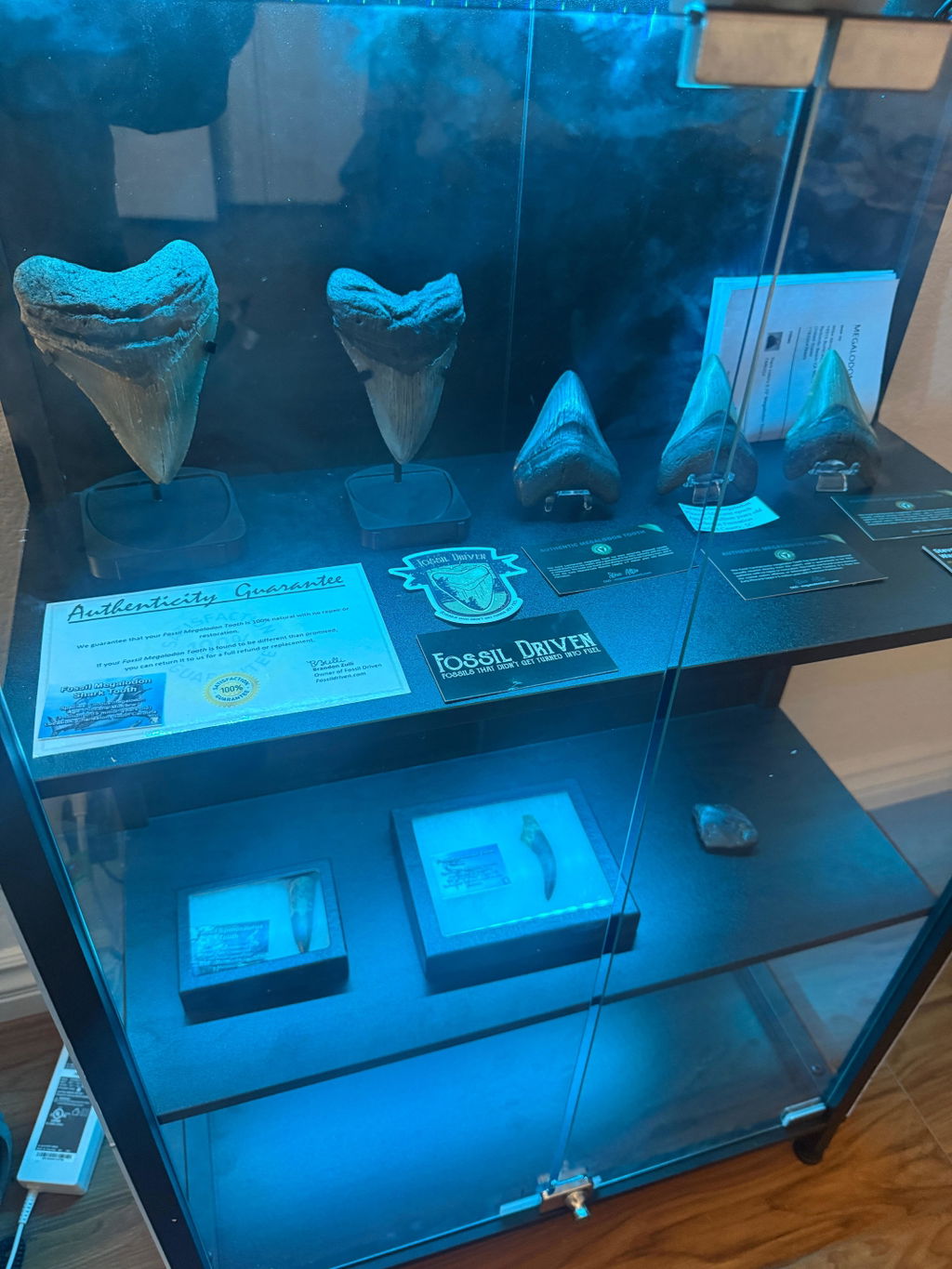
While megalodon itself is long gone, its teeth are very much real and still being discovered today. Millions of fossilized megalodon teeth have been recovered from fossil deposits around the world, ranging from small 2-inch juvenile specimens to massive examples exceeding 7 inches. These fossils are genuine relics of one of the most extraordinary predators in Earth's history, and they are accessible to collectors at a wide range of budgets. Browse our collection of authentic megalodon teeth for sale or read our complete megalodon tooth buying guide to learn what separates a great specimen from an average one.
The megalodon is gone. But holding one of its teeth in your hand, something that survived millions of years of burial in ancient sediment, is about as close as anyone is ever going to get to this animal. That is a pretty remarkable thing on its own. Learn more about where megalodon teeth are found around the world and what makes each location unique.
Written By: Brandon Zulli, Owner of Fossil Driven