
How to Spot Fake Fossils Before You Buy
Share
A fossil can look impressive in a photo and still be wrong in the ways that matter to a collector. The edges may have been rebuilt, the matrix may be fabricated, or the piece may be a modern cast sold as the real thing. The goal here isn't to make you suspicious of every specimen; it's to help you recognize what authentic fossils actually look like, how restoration is normally handled, and when a deal stops making sense.
That matters whether you're buying your first megalodon tooth, adding a trilobite to a display case, or picking out a gift that needs to feel legitimate. A real specimen can carry repair work. A beautiful specimen can carry restoration. What separates an honest piece from a fake usually comes down to disclosure, not perfection.
Know the category before you know the red flags
Fossils aren't one broad category with one set of warning signs. Fake amber, fake trilobites, reconstructed dinosaur claws, and restored megalodon teeth each show different tells, and a buyer who knows what's normal for a specific fossil type is much harder to fool than one who's just judging “does this look old?”
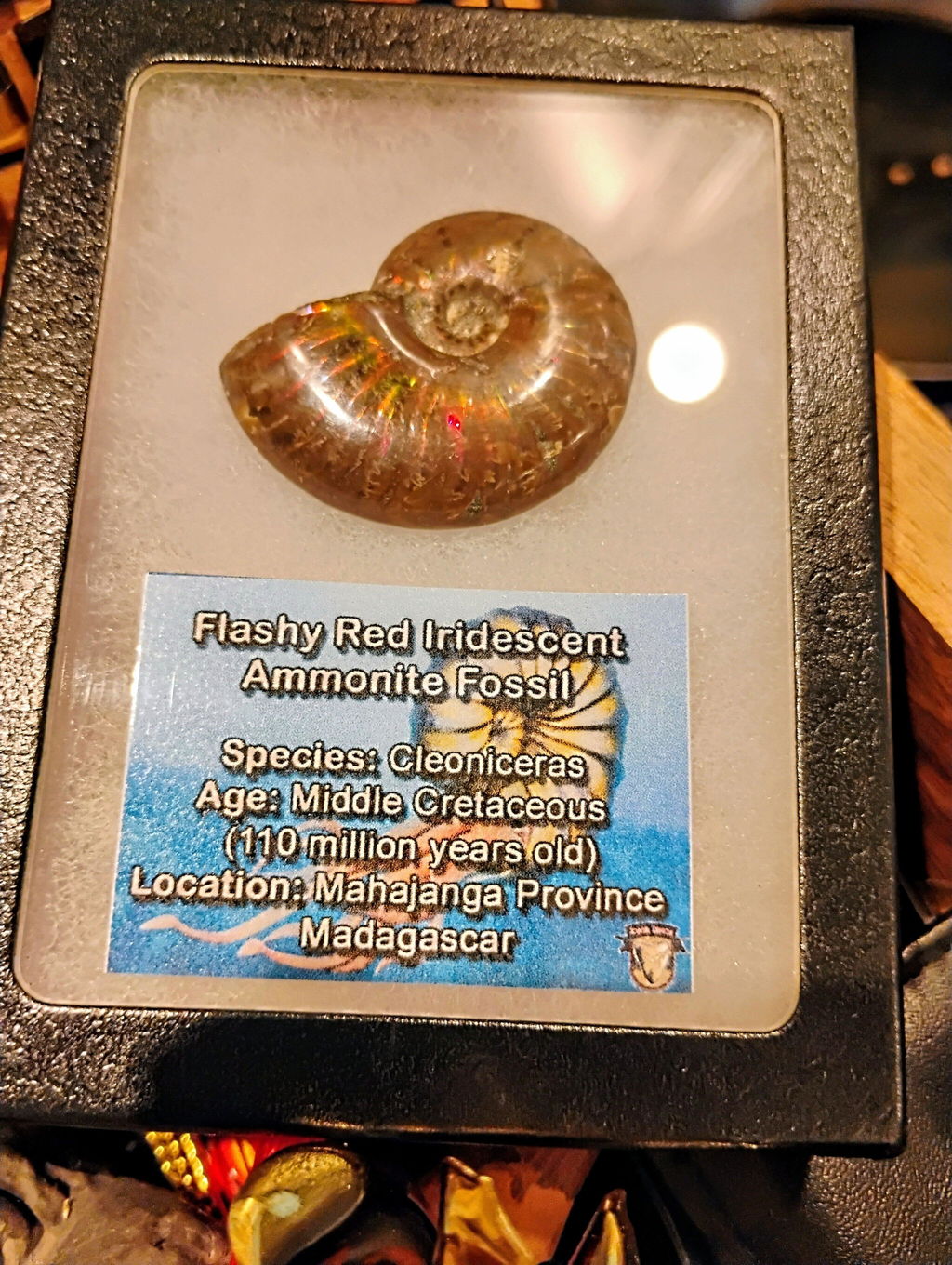
A real megalodon tooth typically shows natural bourlette texture, enamel variation, feeding wear, and edge chips that hold up under close inspection. A real ammonite can be polished and still authentic, but the chamber pattern and shell symmetry should stay consistent throughout. A trilobite shouldn't look like every spine was carved yesterday with identical depth and crispness. The more perfect a specimen looks in the wrong way, the more it deserves a second look.
This is one reason serious collectors gravitate toward specialists: dealers who've handled thousands of a given fossil type can usually spot fabrication at a glance, in a way a generalist can't.
The red flags most buyers miss
Fake fossils rarely announce themselves. They rely on buyers being impressed by size, symmetry, and price. If a specimen is unusually large, unusually complete, and unusually cheap all at once, that combination alone is worth pausing on.
Unnatural uniformity is the biggest tell. Real fossils carry variation, color shifts, minor wear, subtle asymmetry, texture differences. When every surface is evenly colored, every edge is sharp, and every detail is machine-clean, that points toward casting, carving, or heavy cosmetic work.
Matrix mismatch is the second. Some altered fossils get their credibility from embedding a real fragment into fake rock, or carving detail into a prepared slab. If the fossil and its surrounding matrix don't seem to belong together, grain, color, hardness, or contact lines that don't add up geologically, trust that instinct.
Seller behavior rounds it out. Vague descriptions, no mention of repair, no close-up photos, and no authenticity policy aren't small oversights. A seller who knows their buyers cares about restoration and provenance will say so upfront, unprompted.
When the price doesn't add up
Fossil pricing varies enormously by size, completeness, rarity, and demand, so price alone isn't always a reliable signal, but extremely low pricing on a supposedly premium piece is worth investigating. An investment-grade megalodon tooth shouldn't be priced like a souvenir. A large, fully-spined trilobite with exceptional detail shouldn't show up with zero documentation. Bargains exist, but category-defining specimens rarely slip through the market unnoticed.
When the story does the selling
If a listing leans on romance but skips the facts, slow down. “Museum quality” and “rare” mean very little without a species ID, locality, condition note, or mention of restoration. A great story is a bonus; it shouldn't be a substitute for information.
Repair, restoration, and composites: what's normal vs. what's not
Repair isn't fraud. Restoration isn't automatically a problem. Composite pieces aren't inherently deceptive, provided they're disclosed. The real issue is whether the seller told you and whether the added work is proportional to what's being sold as “original.”
A megalodon tooth with a professionally repaired root can still be a desirable, legitimate collector's piece. An ammonite with stabilized cracks can still be fully authentic. A trilobite assembled from several specimens and sold as one untouched fossil is a different story entirely.
In photos, look for: sudden texture changes, abrupt color transitions, filler visible in cracks, repeated patterns, and seams where sections meet unnaturally. Added material often reads smoother, duller, or flatter than the surrounding original. On a polished ammonite, this can be especially easy to miss, since a high-gloss finish already smooths out a lot of surface variation; look instead at whether the chamber lines and suture patterns stay consistent under the polish.
For shark teeth specifically: check the bourlette, root lobes, and serrations closely. Rebuilt serrations tend to look too even. Reconstructed tips often have a different sheen than the original enamel, and added root sections may sit just slightly outside the tooth's natural shape.
Example: a megalodon tooth with a genuinely original root shows serration wear that's irregular, some worn flat, some still sharp, following the tooth's actual bite history. A rebuilt root often shows serrations that are uniformly crisp all the way around, with a faint color break where the repair meets the original enamel. If you see that kind of clean break line, ask the seller directly whether the root has been restored; a legitimate seller will tell you plainly.
Photo Red Flags: How to Spot Fake Fossils Online
Start by looking for multiple angles: front, back, side profile, close-ups, and shots under neutral lighting. A single dramatic hero shot tells you far less than a boring, well-lit set.
Watch for lighting that hides texture: heavy shadows and oversaturated color can make repairs disappear. If every photo is staged for mood rather than detail, you may not be getting what you need to make a real assessment.
Zoom in on edges and transitions specifically; that's usually where casting seams, filler lines, saw marks, and modern tooling show up first. If the photos are too low-resolution to inspect closely, ask the seller for better ones. A serious dealer won't mind; informed buyers are the ones who come back.
Provenance and identification
You don't need a full museum paper trail, but you do want a seller who can explain what the specimen is, where it came from, and how confident that identification is. Fossils from well-documented collecting regions carry useful context; the geology should match the story.
A famous species name attached mainly because it sells better is a red flag; even when it's not outright fraud, misidentification still affects value and trust. This matters most in high-interest categories like dinosaur material, amber inclusions, and marine reptiles, where excitement tends to outrun expertise and replicas show up more often.
When prep quality blurs the line
Preparation can make a real fossil look questionable, or make a fake one look convincing. Aggressive prep can oversharpen features, flatten natural texture, or strip away the subtle signs collectors rely on. Poor prep can leave tool chatter that resembles carving.
Context helps here: fossils from certain regions are routinely prepped in specific, recognizable ways, especially trilobites and fish fossils. The real question is whether the prep reveals the specimen honestly, or creates anatomy that was never there. This is exactly where experienced dealers earn their reputation: they know the difference between standard commercial prep and a specimen that's crossed into fabrication.
Questions worth asking before you buy
A few direct questions can save you money and disappointment:
● Does this fossil have any repair, restoration, or added material?
● Is it a composite of multiple specimens?
● Where was it found, and how certain is the identification?
● Can I get close-up photos of any area I'm unsure about?
A reputable seller answers these clearly and without defensiveness. Evasive replies, shifting details, or answers that sound copied from a script are worth paying attention to.
The bottom line
Learn a few fossil categories well, compare real specimens against each other, and buy from people who know the material and stand behind it. That doesn't mean every general seller is unreliable; it means expertise has real value in a market where repair, composites, and replicas are common.
At Fossil Driven, that confidence comes from expert sourcing, category-specific knowledge, and straightforward answers about condition and authenticity. Whether you're after a display-worthy megalodon tooth or a first fossil for someone who'll love it, buying from a seller who explains the piece honestly beats chasing the flashiest listing every time.