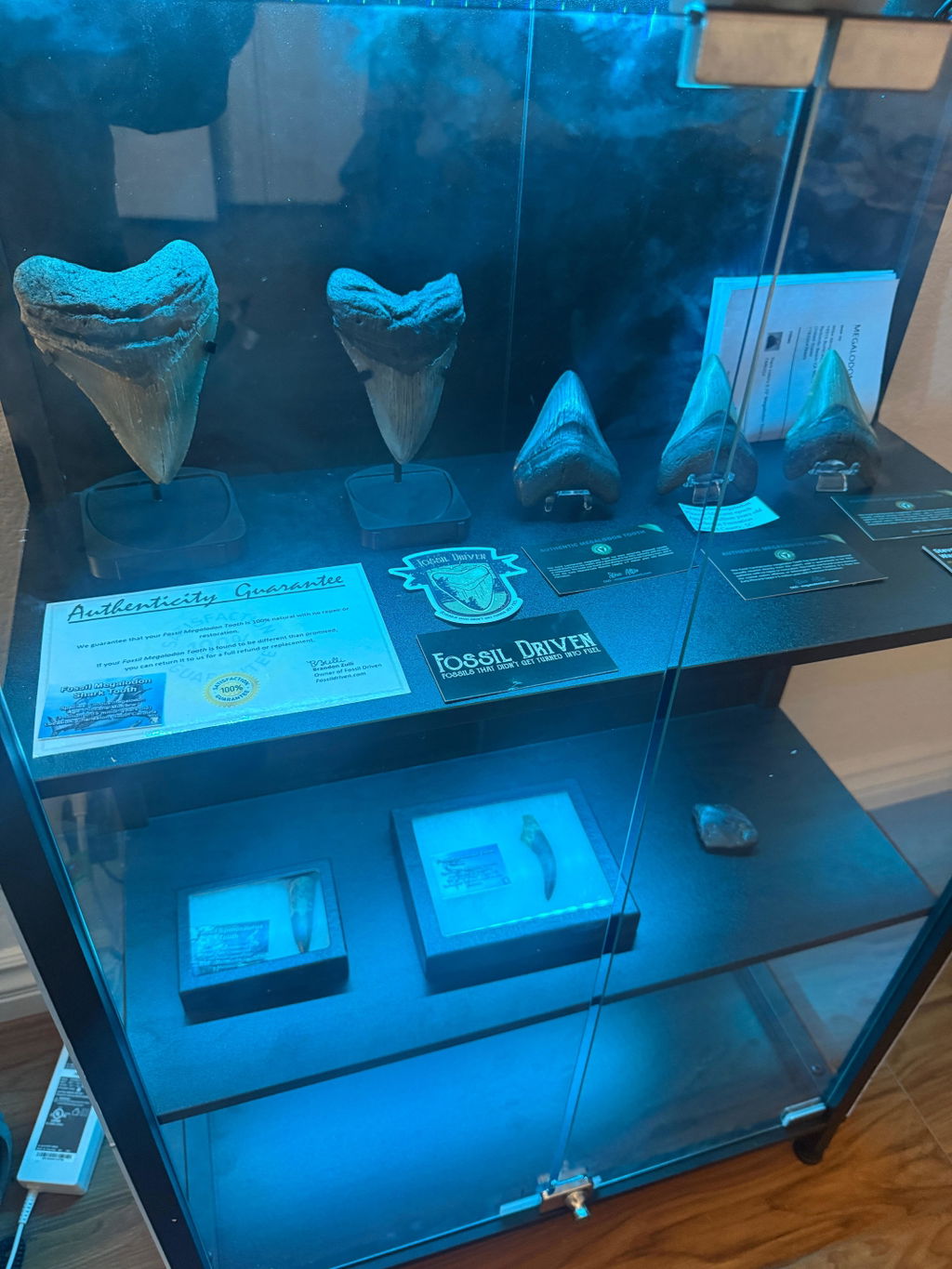

Which Megalodon Tooth Size Is Right for You? | Fossil Driven

For most buyers, the sweet spot is usually between 4 and 5 inches. This size range offers one of the best balances of display impact, affordability, availability, and collector appeal. A quality 4- to 5-inch tooth feels substantial in hand, displays beautifully on a shelf, desk, or cabinet, and gives buyers a much wider range of options than the largest premium specimens.
If someone asks me for a recommendation without giving a budget, I almost always suggest looking in this range first. These teeth are large enough to impress, but common enough that collectors can focus on quality rather than simply finding something within budget.
With all that being said, there is no universal "best" size. A well-preserved 3.5-inch tooth with razor-sharp serrations, phenomenal coloration, and a complete root can be far more desirable than a heavily restored 5-inch specimen. Experienced collectors understand this, and new buyers should too.
Should You Buy the Biggest Tooth You Can Afford?
Normally, no.
A slightly smaller tooth with stronger preservation often provides more long-term satisfaction than a larger specimen with obvious flaws. Collectors tend to pay attention to the overall quality and eye appeal long after the novelty of a measurement wears off. One of the most common mistakes new buyers make is chasing size while overlooking quality. A fossil is a display piece, not simply a statistic. The goal is to find a specimen that looks impressive every time you see it, not just one that sounds impressive on paper.
A better strategy is to establish a budget, decide which size range best fits your goals, and then purchase the strongest specimen available within that range.
What Size Tooth Do Most Collectors Start With?
Many collectors begin with a tooth between 3 and 5 inches. These specimens are often affordable, visually appealing, and available in enough variety that buyers can learn what characteristics matter most to them.
One thing that I have noticed over the years is that many first-time buyers initially focus almost entirely on size. After owning a few specimens and being in the business for over 13 years, they began paying more attention to details such as color, location, and the overall quality of the Megalodon tooth. The first tooth often teaches collectors what they personally value in future purchases. A smaller but higher-quality specimen can be a much better introduction to collecting than a larger tooth with significant restoration work.
Which Size Sells the Fastest?
One of the most common questions I get is which size range sells the fastest. In my experience, whole teeth in the 3- to 5-inch range tend to move more quickly than almost any other category. 6-inchers sell quite slowly, and 2-inchers are good, but they don't move as quickly as their slightly bigger counterparts.
They appeal to a wide audience. First-time buyers find them impressive without being prohibitively expensive. Gift buyers appreciate their display presence. Experienced collectors can still find excellent examples with beautiful color, sharp serrations, and overall phenomenal quality. The largest teeth often attract the most attention, but the best 4- to 5-inch specimens frequently generate the most consistent demand because they strike a balance between rarity, affordability, and visual appeal.
Under 4 Inches
This size range is often ideal for budget-conscious buyers, younger collectors, gifts, jewelry projects, or anyone who simply wants an authentic piece of prehistoric history without spending heavily. Do not assume smaller Megs means lower quality. Some of the most attractive megalodon teeth I have handled were under 4 inches. Razor-sharp serrations, beautiful coloration, and complete roots can make a smaller tooth far more impressive than buyers expect.
The primary tradeoff is display impact. On a large shelf or in a collector cabinet, an under 4-inch tooth may not command the same attention as a large 5-inch Megalodon tooth. If your goal is a centerpiece display fossil, you may eventually want something larger.
4 to 5 Inches
For many collectors, this is the ideal category. These teeth are large enough to feel impressive, yet common enough that buyers can compare multiple examples and focus on quality rather than simply finding one available. This size range also provides the greatest flexibility. Instead of stretching your budget for the largest tooth possible, you can often choose a specimen with better enamel, cleaner serrations, nicer coloration, and a more attractive overall shape.
Many of the best display pieces I have sold over the years fall into this category because they combine size and preservation in a way that appeals to both new and experienced collectors.
Over 5 Inches
Once you move beyond 5 inches, you enter a much more competitive part of the market. These teeth have significant display appeal and are often the specimens that stop people in their tracks. I know that happens to me a lot at my farmers' markets.
However, this is also where patience becomes important. Large teeth with sharp serrations, gorgeous coloration, little to no restoration, a full bourlette, and complete roots become increasingly difficult to find as size increases. Many buyers focus on crossing the 5-inch threshold because it feels like a milestone. In reality, a mediocre 5.25-inch tooth may be far less desirable than an exceptional 4.75-inch specimen. The larger the tooth, the more important the quality becomes.
For serious collectors, a large, high-quality tooth can anchor an entire collection. But buying solely for size is rarely the best strategy. There's so much more that goes into buying teeth.
The Right Size Depends on Your Goals
If you are buying your first megalodon tooth, a quality specimen between 4 and 5 inches is usually an excellent place to start. If you are shopping for a gift, that same range often provides the best combination of display presence and value. Collectors focused on building an advanced collection may eventually pursue larger specimens, unusual colors, pathological teeth, or exceptionally preserved examples. In those situations, quality becomes even more important than size.
Frequently asked questions
What's the most popular megalodon tooth size? In my experience, teeth in the 3- to 5-inch range sell the fastest and stay the most popular overall. They hit the sweet spot of display impact, affordability, and availability.
Is a bigger megalodon tooth always worth more? Not necessarily. Size is one factor among several, including preservation, serration sharpness, color, and how much (if any) restoration the tooth has had. A smaller tooth in excellent condition can be worth more than a larger one with heavy restoration.
What size megalodon tooth is best for a beginner collector? A quality tooth in the 3- to 5-inch range is usually the best starting point. It's large enough to feel impressive while still being widely available, so you can compare multiple specimens and learn what matters to you before spending more on a larger piece.
Why do 6-inch megalodon teeth sell more slowly than smaller ones? In my experience, larger teeth move more slowly mainly because of price point and rarity; there's simply a smaller pool of buyers shopping at that level, and it takes longer to find the right one for each piece.
Are smaller megalodon teeth (under 4 inches) good quality? Size has nothing to do with quality. Some of the most attractive teeth I've handled, with razor-sharp serrations and beautiful coloration, have been under 4 inches. They're a great option for anyone who wants an authentic specimen without the price tag of a larger piece.
Find the right size for you
The best megalodon tooth is not always the largest one. It is the specimen that fits your budget, displays beautifully, and still excites you years after you bring it home.
👉 Browse by size: Under 4" · 4-Inch · 5-Inch · 6-Inch · Full Collection
Written by: Brandon Zulli - Owner of Fossil Driven